Vignette

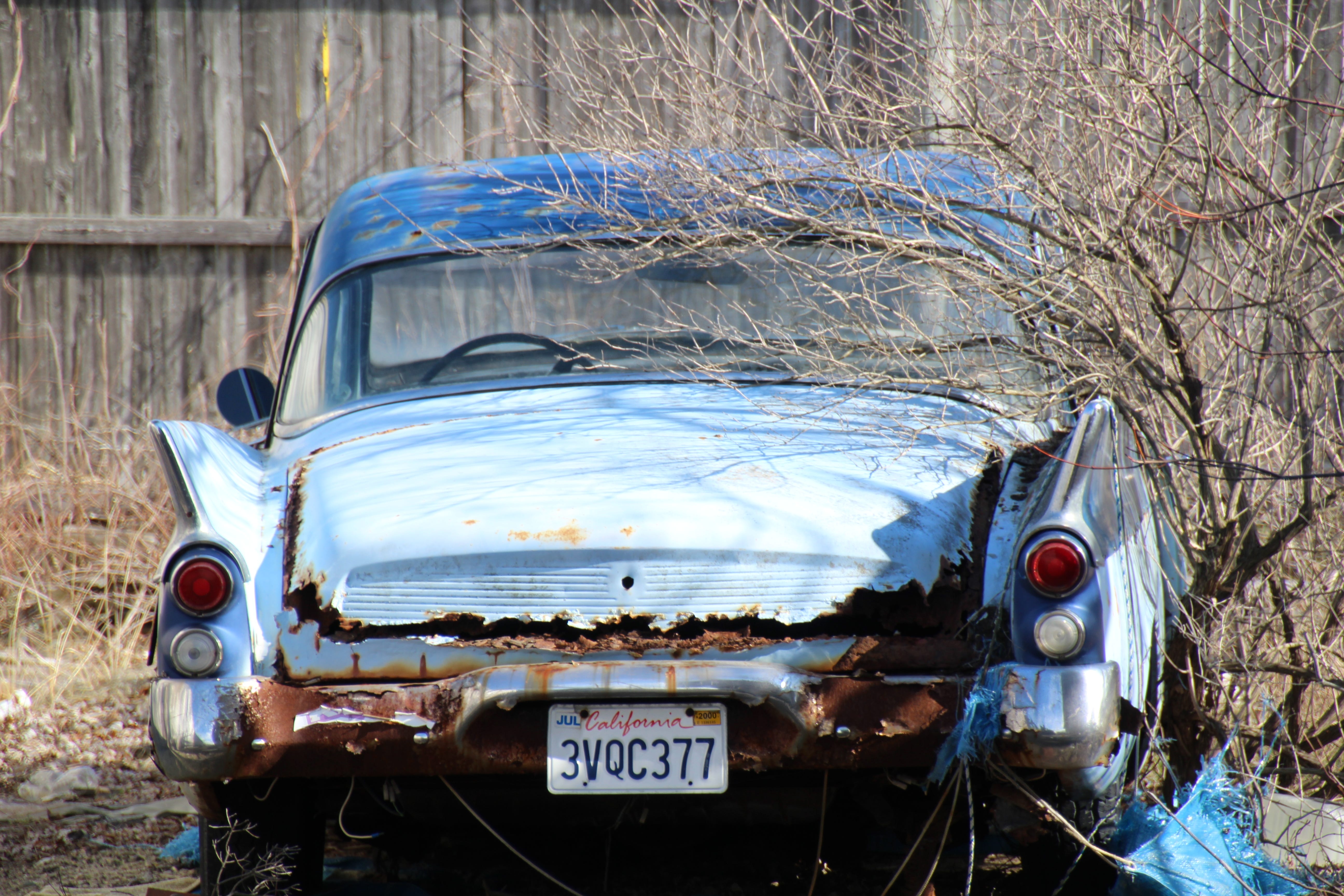
I wrote these words the day I took this photo.
Years counted by rolls of the odometer.
Highways always under construction.
The right road folllowed
More often than the wrong turn taken.
Dented, rusted, Kerouac and fumes.
The textures of a life
Wandered, wondered and lived
But not forgotten.
That was almost eight years ago. Since then I’ve thought about that old car and the lives it may have traveled through. I’ve had dreams about it. Dreams in black and white Super 8mm and Kodachrome 35mm. Some had no sound, some were in full Dolby Surround Sound. I’ve connected the fragments and filled in the blank spaces. An exercise in curiosity.
***
The plan had always been time in the Army followed by a job in the mill and a union card. It was family tradition. Three tours in the jungle changed all that. He came home in the spring of 1972 with three chevrons on his sleeve and a lot of questions about what he had seen and who he had become. The Army returned him to Oakland, CA. Rather than fly back east, he took a bus. He sat behind the driver on the first leg of the trip. A veteran of the Korean War who shared pieces of history of the towns, mountains and rivers they passed by. He watched America through the window and realized he knew more about Southeast Asia than he did of his own country. The Brass Hats in the Army had told him he was fighting for the safety and security of his country. Other than textbook history he memorized momentarily for tests in high school, he didn’t know all that much about what America was like outside of the mill town he had grown up in. By the time he got off the bus he had decided to find out.
His homecoming was quiet and unmarked by anyone outside the family. His father took the end of the week off to spend with his son. They loaded hip boots and fishing gear into the back of the old F100 and drove out to the Farmington one morning. The last time they had fished there was just before he shipped out to boot camp. He, his father and his grandfather. It seemed like yesterday. But it wasn’t. They were both reminded of this as his father handed him his grandfather’s prized Shakespeare Wonderod with matching Wondereel.
“This is one of the things he wanted you to have.”
They fished quietly all day, neither of them catching anything, both not knowing what to say but knowing neither needed to. At the end of the afternoon they decided to return home for dinner and then go to the VFW to watch the Bruins in game six of the Stanley Cup against the Rangers. His father steered them to stools at the end of the bar, close enough to see the television but far enough away to have a conversation. They hadn’t yet spoken of the war. His father had never talked about his service in World War Two, but that night, as they watched the Bruins win, he did. Father and son shared stories about friends, fear and death. It was the closest they had ever been and the last time they ever talked about such things.
Over one last beer, his father said, “Well, son, there’s a place for you at the mill if you want it. There always will be. What do you think you want to do?”
After a long period of silence, he looked at his father and said, “I don’t know. I need some time. I’ve got some money saved; I want to backpack across America.”
He told his father about the bus ride across the country, the small towns and big cities he had seen and the people he met in them. “There’s a history out there and a way of life in the people and in the places that we’re not told about. I met a bus driver who knows more about American history than any teacher I ever had. I want to find about it from the people who lived it.”
The next morning while having coffee with his parents, his mother handed him a set of keys. “There’s something for you outside,” she said.
They followed him out to the driveway. It was his grandfather’s car. His father, with a crackle in his voice said, “He wanted you to have this when you got home. This might get you to more places than backpacking.”
He spent the next few days outfitting the car with what he needed. Surplus store camping and cooking gear, clothing for all seasons, the Wonderod and a Rand McNally Interstate Road Atlas a neighbor gave him. His parents set an old wooden milk crate on the passenger seat. It contained half a dozen notebooks, an old Canon FX 35mm camera and a few rolls of film. His mother said, “Stop every once in a while, and write about what you see, who you meet and what you feel so you can share it someday.”
He left Massachusetts at sunrise the next morning. He hugged his mother, shook his father’s hand and started driving.
He didn’t just drive across America; he drove into it. Route 1 and A1A, I-90, the Blue Ridge Parkway, Route 66, the PCH, he travelled them all turning off onto the local routes and dirt roads that connected big cities and small towns to the rest of the country. He camped where he could or slept in the car in parking lots. He talked to everyone he met in diners, taverns and gas stations. He spent time with construction workers on their lunch breaks, milkmen making their rounds and farmers working in their fields. Early into the trip one of these farmers offered him a place to set up his tent, three meals a day and a few dollars for a week’s worth of work. He gladly accepted. This became a common occurrence that not only helped fund his trip, but also embedded him, for a few days, into the lives of those he encountered and the communities they lived in. He listened to their stories, asked questions about the history of their people, families and the places they lived. He began filling the pages of the notebooks his mother had given him.
He picked apples, oranges, cabbage and potatoes. He milked cows, raked blueberries, delivered firewood and learned to boil sap to syrup. He learned to smoke salmon with the Umatilla, hunt elk with an Apache platoonmate and bow fish from the Seminole. He raised barns with the Amish and Mennonites, worked as a hod carrier for a Chicago bricklayer and poured concrete slabs for a new housing development in Phoenix. He drove cattle on horseback from spring pasture to summer grazing meadows in the Big Horns and returned to help bring them back to the ranch in the fall.
He hiked into Yosemite, Yellowstone, the Grand Canyon, North Cascades and Acadia. He fly fished Slick Rock Creek, the Frying Pan, Blackfoot, Beaverkill and spent three nights on Horton Creek reading A Farewell to Arms. He toured museums and art galleries, visited national monuments and historic battlefields. He saw Led Zeppelin in Tampa and Secretariat at Belmont. He watched the first crew of Skylab launch from the Kennedy Space Center and spent a disappointing day driving around Roswell, New Mexico.
After sixteen months he decided to return home. The dashboard was littered with packs of Beemans, road maps and half-eaten rolls of Necco Wafers. The backseat floorboards were covered with empty cartons of Lucky Strikes, Moonpie wrappers and RC Cola bottles. Scattered on the rear deck were well worn copies of Catcher in the Rye, You Can’t Go Home Again and On the Road. On the passenger seat, the old wooden milk crate was now full of notebooks. Another one beside it held dozens of rolls of undeveloped film. He looked at them as he drove and decided the past that they contained was now going to be his future.
He drove straight through from Cleveland, making one final stop at the state college a few towns away from his home. There, he spoke to an admissions counselor and left with an application. Sitting on the porch with his parents that evening he told them about his plan.
“I’m going to be a teacher. I can pull some shifts at the mill and use what I have in the GI Bill to pay for it. I want to be a history teacher. American history. But I’m going to do it differently. I’ve got two crates full of real history. Stories from people who lived it, and photographs of where they watched it. Some of the stories have been handed down from parent to child as far back as the Revolution. Some are only two or three generations from the actual events. I can use all of it to help students feel closer to history and hopefully, understand it in their own context.”
His mother got up and retrieved a shoebox from the pantry. She handed it to him and said, “Maybe these will help your students as well.” He opened it and smiled. In it were all the postcards and letters he had sent to them during the trip. Each one held a few sentences that corresponded to a page, or sometimes pages, of what he had written in the notebooks.
He took the job at the mill. Nights and weekends. During the day he went to college. Four years later he added a degree in history and a teaching certificate to that box of notebooks.
In 1978, he once again loaded his grandfather’s car and drove across America to a teaching job at a preparatory high school in Northern California. His history classes became the most popular on campus. He used the stories in the notebooks and the photographs converted to slides to teach the required textbooks. The shoebox of postcards his mother kept was used on Friday’s. One student was chosen, based on class participation from that week, to pick out a postcard and read it to the class. He would then tell the class what he remembered of the stories of that place and the people he met there and give them a theme from those memories to write about as an assignment for the next week. They were to write about their own history, a family member or someone from their community. These assignments were never graded, only checked off as being completed. He kept these papers from each student in separate files and at graduation, handed the student their file as they accepted their diploma.
In 2000, upon his retirement and the passing of both his parents, he left California and returned to Massachusetts to the house that he grew up in. This time the car that had taken him to every corner of the country and most points in between, was trailered across it. He took it for a final ride to fish the Farmington and then parked it in the back beside a shed and covered it with a tarp. The shed was finished out as a writing studio. In it he spent his days organizing the stories from the notebooks to write his memoir.
***
I don’t know what happened, why the car stayed covered up or if the memoir was ever completed. My character obviously never existed. At least that I know of. I made him up as I’ve thought about the car and wondered where it traveled to. I created him in the aggregate. A compilation of the people I’ve met, places I’ve been, things I’ve done and wish I had done. The details are not about me. But the idea is. The idea to seek history. To know what came before us, before it is forgotten. Or worse, no longer passed on. I don’t subscribe to history simply being taught. It can be manipulated, processed and force fed to achieve some institutional metric. History should be learned in the crucible of our own lives. In the dirt of curiosity that leads to knowledge. In the process of asking who, what, where, when and why that fosters understanding.
Go.
Wonder.
Wander.
Be curious.
This is good, I greatly enjoyed it. Many of my own characters of the past, even of long before me, are now wanting to tell their story. I think Will give voice to them in my poetry. Thanks.
Very well written!
After arguing about the JFK assassination with multiple history professors who appear to be blind to anything that’s not the establishment’s position, I love this line:
“History should be learned in the crucible of our own lives.”